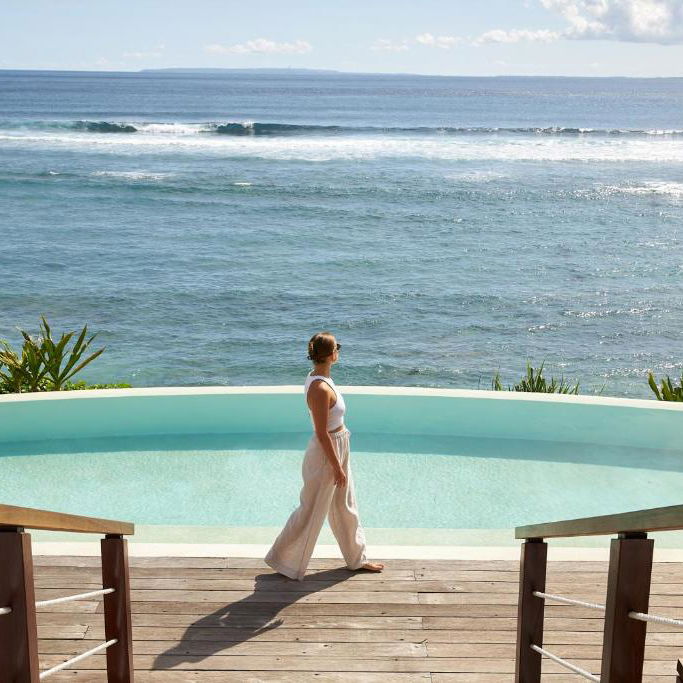
Nusa Ceningan


This riad was not decorated. It was built by hands that never needed a ruler.
Time is invested everywhere here: in the mosaic floors, the carved ceilings, the courtyard fountain, the bathroom walls. None of it is applied decoration. It is the building itself, raised by craftsmen, the maallems, the masters, trained in a tradition centuries old. Apprentices start at twelve or thirteen and need at least seven years before they master the basics.
From the Arabic al zulaycha, little polished stone. The art of mosaic reached its sophistication in the eleventh century, seen in the minaret of the Koutoubia and later refined under the Marinid dynasty in Fez. Tiles are assembled face down, colour against the floor, which demands abstraction and memorisation rather than sight. The clay comes exclusively from Fez, containing some seventy minerals, and passes through more than sixteen production stages. No two tiles are identical. At Ryad Dyor: suite floors, bathroom walls, and the Ennafora fountain in the main courtyard, in sky blue, emerald green, saffron and ivory.

The ceilings of the Basha Deluxe Suite rise five metres, hand-painted cedar carrying patterns three hundred years old. The designs derive from mathematical formulas and ancient symbolism. Atlas cedar is used because it does not warp once cut. The najar, the traditional carpenter, still works it by hand. In the Arab Superior Junior Suite, a carved cedar ceiling is the room's central element.

A lime plaster applied to walls and polished with a river stone for hours until it becomes waterproof and lustrous. It appears in the hammam at Ryad Dyor and in the bathrooms of several suites. It is never reproduced exactly the same way twice. It is not replaced. It is preserved.

Wooden lattice screens, turned piece by piece on a lathe. They serve a double function: filtering the light into a lace of shadow and clarity, and protecting privacy, allowing those inside to see without being seen.

After a few days, you stop seeing the materials separately; you start seeing something coherent. Not ostentation. Depth.
Ryad Dyor. Marrakech Medina. Craftsmanship as a reason for being.








 Carrer de l'Alcalde Jaume Marí Roig, 5,
 info@giridestinations.com
 (+34) 971 33 33 45